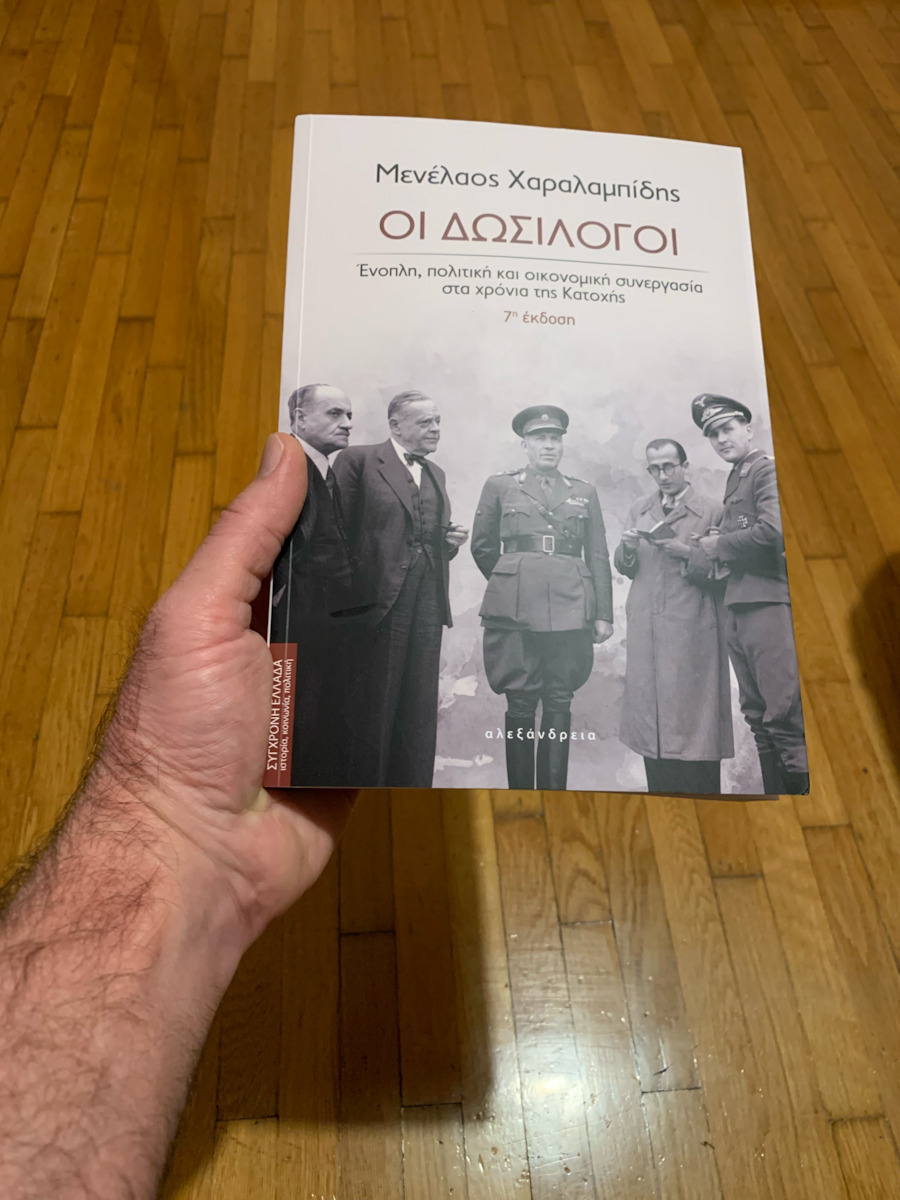
- The various forms of collaboration with the occupier (political, economic, armed).
- The deep division caused by the collaboration in Greek society.
- The impunity of collaborators after liberation and the role of the Greek justice system in this.
In diesem Buch verfolgen wir die politische, wirtschaftliche und bewaffnete Zusammenarbeit mit dem Besatzer, wie sie sich in der Region Attika manifestierte. Durch das Studium von Archiven, die erstmals veröffentlicht werden, werden die Handlungen derjenigen, die kollaborierten, beschrieben, die Gründe und Mechanismen für die Entwicklung des Kollaborationsphänomens untersucht sowie die politischen und wirtschaftlichen Bedingungen, die sein Entstehen begünstigten. Die von den drei griechischen Besatzungsregierungen verfolgten Politiken, die Rolle von Kaufleuten, Industriellen, Bauingenieuren und anderen bei wirtschaftlichen Transaktionen mit den Besatzern, die Aktionen der griechischen königlichen Gendarmerie, der Sicherheitsbataillone, der griechischen Agenten der SS und anderer, die den bewaffneten Arm der Kollaboration bildeten, und ihre gerichtliche Behandlung nach dem Ende der Besatzung stehen im Mittelpunkt dieser Studie.
Die Zusammenarbeit mit dem Besatzer prägte das Alltagsleben in ganz besetztem Europa. Politiker, Militärangehörige, Geschäftsleute, Bürgermeister, Richter, Priester, Journalisten arbeiteten aus vielen verschiedenen Gründen eng mit den Besatzungsbehörden zusammen. Der anfänglich scheinbare Sieg Deutschlands im Krieg, Antikommunismus, der Erwerb von schnellem und leichtem Reichtum, ideologische Ausrichtung an nationalsozialistisches Deutschland und faschistisches Italien, das Bedürfnis nach Überleben, waren einige davon. In Griechenland, obwohl seit dem Ende der Besatzung ganze 80 Jahre vergangen sind, bleibt das Thema der Zusammenarbeit mit dem Besatzer ein Tabuthema. Dies ist das Ergebnis der politischen Vergessenheit, die alle Nachkriegsregierungen in ihrem Versuch, die politischen Folgen des beispiellosen, in Intensität und Ausmaß kollektiven Traumas, das der griechischen Gesellschaft durch die Kollaboration zugefügt wurde, zu bewältigen, verfolgt haben. Die Zusammenarbeit mit dem Besatzer war der Ausgangspunkt der neuen Spaltung, die mit dem Beitrag anderer Faktoren zu den Bürgerkonflikten der Besatzung, den Dekemvriana und letztlich zum Bürgerkrieg der 1940er Jahre führte.
In the book you will meet
- The various forms of collaboration with the occupier (political, economic, armed).
- The deep division caused by the collaboration in Greek society.
- The impunity of collaborators after liberation and the role of the Greek justice system in this.
Why We Loved It
The book sheds light on a dark aspect of the Occupation period in Greece, highlighting the extent and intensity of the phenomenon of collaboration with the occupier. It explains how this collaboration was not only the result of coercion but was also based on consent, offering incentives and benefits to the collaborators. Furthermore, it analyzes how post-war Greece dealt with (or rather avoided dealing with) this trauma, leading to impunity and oblivion.
This book is for you if…
Are you interested in the Greek history of the Occupation and want to learn more about its complex and often overlooked aspects, such as collaboration with the Germans and Italians and its long-term consequences on Greek society?
Read an excerpt
“Never until today, despite having witnessed all the moral collapses of this era and the most pitiful ones, have we ever had such an unmasked and raw contact with our disgrace and downfall. [...] Yesterday was a day of shame for all Greeks. [...] Because yesterday, with the trial that began, one of the filthiest sewers that have ever left their moral stench in the atmosphere of Athens was opened. We relived the worst hours of the occupation. Not the German one [...] We are talking about the Greek occupation. [...] We are talking about the Security.”
With these words, the journalist of the centrist newspaper Eleftheria described the start of the largest trial of collaborators with the occupier, following that of the occupation governments, which took place at the Special Court (of Collaborators) in Athens in October 1945. It was the trial of the leadership group of the Special Security of the Greek Royal Gendarmerie. What is striking is the journalist's reference not to the German but to the Greek occupation. It is not a figure of speech but a painful reality. This is shown by the study of the phenomenon of collaboration.
By the term “Greek occupation,” the above journalist described the escalation of the phenomenon of collaboration with the occupier, as it manifested in the last year of the Occupation through the development of its armed form. The path of collaboration had opened long before the Gendarmerie men took action along with other armed collaborators of the German Occupation Authorities in the streets of Athens and Piraeus. It was inaugurated by the Greek generals who formed the first collaboration government and the army of businessmen and various adventurers who rushed to work on behalf of the Occupation Authorities.”
Skroutz users who read it said:
Readers of the book speak of an excellent and thorough research by the author, with many sources and documentation, that deeply illuminates the subject of collaboration with the occupier. Many emphasize that it is a fantastic and unique book about the Occupation period, revealing events that are shocking and help you understand a lot about Greek society and the reasons for its division, both then and now. It is characterized as a landmark book that all Greeks should read, as it shows how the extensive collaboration was "forgotten" and remained unpunished after liberation, with many collaborators retaining positions of power. Despite the gravity of the subject and the in-depth research, most agree that it is very easy to read. Some opinions mention that it does not delve deeply enough into the causes of collaboration, but the general feeling is that it is a revealing and worthy of study work.
About the Author
Menelaos Charalambidis, born in Athens in 1970, is a historian with studies in economics and history. He has published the books "The Experience of Occupation and Resistance in Athens" (2012) and "The December Events 1944. The Battle of Athens" (2014) by Alexandria Publications. He has been systematically involved in Public History since 2013, conducting historical walks in Athens for the period of Occupation and the December Events and participating in the design of the postgraduate program "Public History" at the Hellenic Open University. He was also the inspirer of the actions "October 12, 1944. Athens Free".
Hersteller
Produktanleitungen
- Autor
- Menelaos CHaralampidis
- Verleger
- Alexandreia
- Skroutz Buchpreise 2025
- -
- Tastaturen
- Akademisch
- Motiv
- Neuere und moderne Griechenland
- Sprache
- Griechisch
- Untertitel
- Bewaffnete, politische und wirtschaftliche Zusammenarbeit während der Besatzungsjahre
- Abdeckung
- Weich
- Anzahl der Seiten
- 448
- Veröffentlichungsdatum
- 9/2024
- Veröffentlichungsdatum
- 2024
- Abmessungen
- 17x24 cm
- ISBN-13
- 9786182230343
Wichtige Informationen
Spezifikationen werden von offiziellen Hersteller-Websites gesammelt. Bitte überprüfen Sie die Spezifikationen, bevor Sie Ihren endgültigen Kauf tätigen. Wenn Sie ein Problem bemerken, können Sie melden Sie es hier